
What "balanced" actually means
Balanced training uses all four quadrants of learning: positive reinforcement (add something good), negative reinforcement (remove pressure the moment the dog gets it right), positive punishment (a fair correction for a behavior the dog already understands), and negative punishment (take the good thing away when the dog makes the wrong choice). The vast majority of the work is the first two — teaching, rewarding, and showing the dog how to turn pressure off. Corrections are rare, because a well-trained dog rarely needs one. But they're in the toolbox, and they have weight behind them when they're used.
The word gets misused a lot. Balanced doesn't mean harsh. It doesn't mean corrections first. It means honest: the dog gets a clear yes and a clear no, and both of them mean something.
Where purely positive falls short
Let's be fair first: purely positive, or force-free, training is good at what it does. It's the best way to teach a new behavior, it builds a willing dog, and for easy dogs in easy situations, it can be enough. Plenty of people love it, and plenty of dogs do fine with it.
But it has a hard limit, and the limit is the real world. A treat can't always beat a squirrel. It can't beat another dog across the street, a deer at the edge of the yard, or a kid on a bicycle. Some behaviors don't stop because you paid the opposite one — a dog that lunges at strangers doesn't quit because you fed him for sitting once. And some behaviors are dangerous enough that they have to stop the first time: chasing cars, bolting toward a road, going after another dog. In those moments, a trainer with only treats has nothing to say to the dog — and the dog knows it.
That's not a criticism of the people doing it. It's a fact about the tool. When the only tool you allow yourself is a reward, the dog only listens when the reward is worth more than the distraction. And out in the world, the distraction usually wins.
What a balanced dog actually looks like
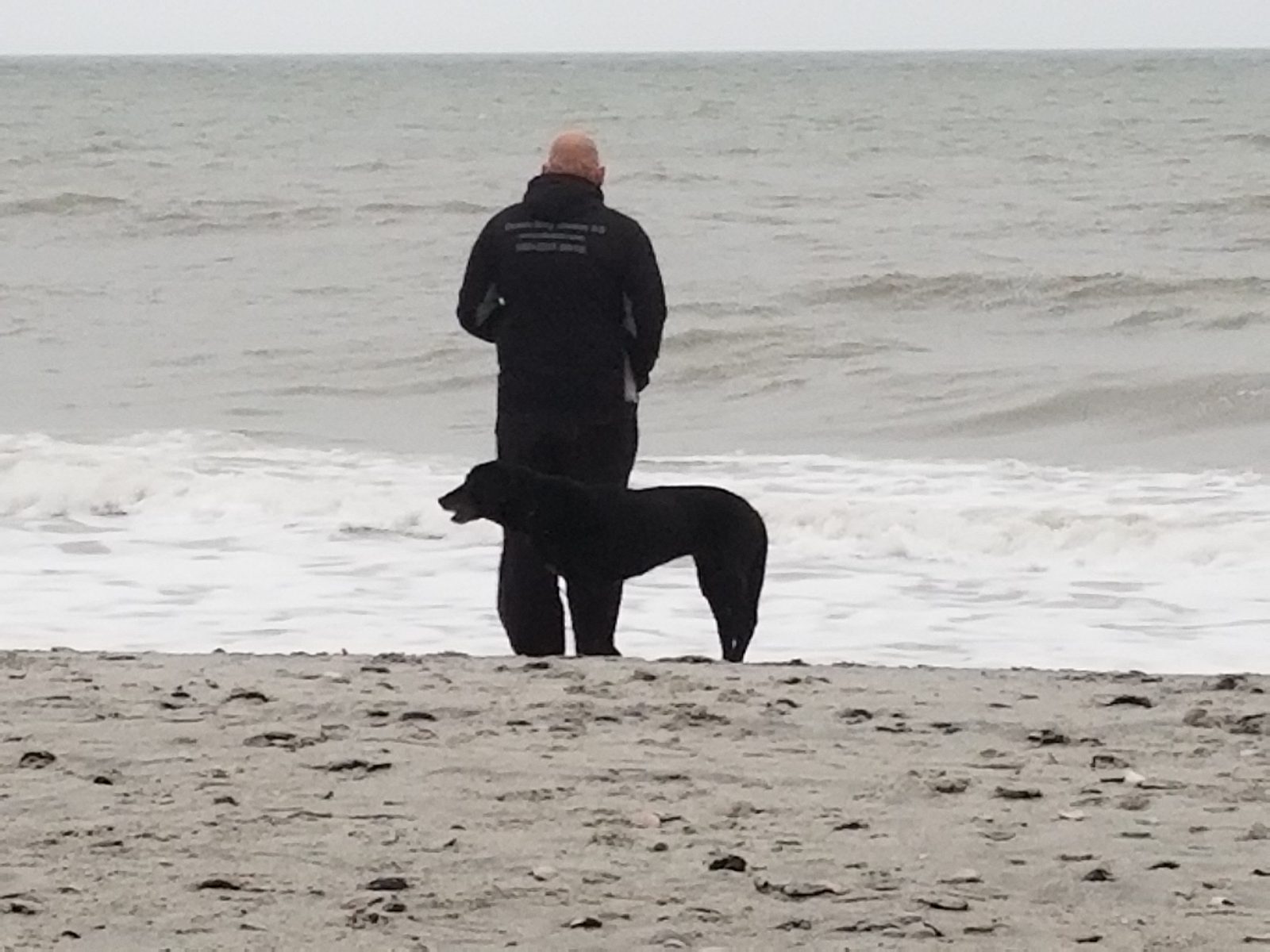
He's the dog off-leash at the beach who comes back the first time you call — not because he's afraid of you, but because the communication is so clear there's nothing to be confused about. He knows what earns a reward, he knows how to turn pressure off, he knows what "no" means, and he knows calm behavior is what keeps the good things coming. That's a dog with freedom: off-leash walks, the beach, the park, the front yard — because his owner can trust him there.
That freedom is the whole point. A dog that only works for cookies is on a short leash — the length of your treat pouch. A dog that understands all four quadrants can be trusted with real freedom, in real places, around real distractions. And a dog with freedom is a happier dog.
The honest part: corrections done badly are bad training
None of this is a defense of heavy-handed training. A correction delivered in anger, too late, too hard, or for something the dog was never taught is not balanced training — it's just bad training, and it creates fearful, shut-down dogs. The standard we hold is simple: teach the yes first, correct only a behavior the dog already understands, use the lightest level that works, and be done with it the second it lands. The e-collar, used the right way, is communication — a tap on the shoulder, not the heavy-handed approach it got its reputation from.
If a trainer's answer to every problem is a harder correction, that's not balance either. Balance means the correction is the smallest part of the work, not the biggest — and it means the dog spends most of his training life being rewarded, not corrected.
The goal was never obedience for its own sake. It's a dog you can trust anywhere — at home, on the street, off-leash at the beach. That trust is built with all four quadrants, used fairly, in the right order, at the right time.
Read the four quadrants: 1. Positive Reinforcement · 2. Negative Reinforcement · 3. Positive Punishment · 4. Negative Punishment